

Average Cost & Price per Square Foot
Metro-wide, most 2026 Twin Cities construction runs $230–$500 per square foot depending on build type, with the mid-market concentrated around $300–$400 and luxury and lakefront estates reaching $700–$1,000+. These figures are construction cost only; land, demolition (for teardowns), and financing are additional.
| Build type | Cost / sq ft (2026) | Notes |
|---|---|---|
| Production / community build | $230–$300 | Set plans in builder-developed communities; lot often bundled. |
| Semi-custom | $250–$400 | Builder plans with structural and finish modifications. |
| Custom | $300–$450 | From-scratch design on your lot; architect or design-build. |
| Luxury custom | $450–$700 | Premium materials, complex architecture, high-touch process. |
| Ultra-luxury / estate | $700–$1,000+ | Lakefront and estate work; effectively uncapped at the top. |
| Modular | $150–$250 | Factory-built sections, site-assembled; excludes land/site work. |
| Barndominium | $120–$220 | Post-frame/steel shell with finished interior; shop space cheaper. |
Remodeling an existing house rather than building new? Those budgets work differently — see cost to remodel a house in Minnesota, which prices kitchens, baths, basements and additions from published Minneapolis data.
Deep dives on the alternative build types: modular homes in Minnesota, barndominiums in Minnesota, and tiny homes in Minnesota. At the top of the market, where the lot's own rules move the budget as much as the finish level does, see luxury home builders in Minnesota.
Cost by Home Size
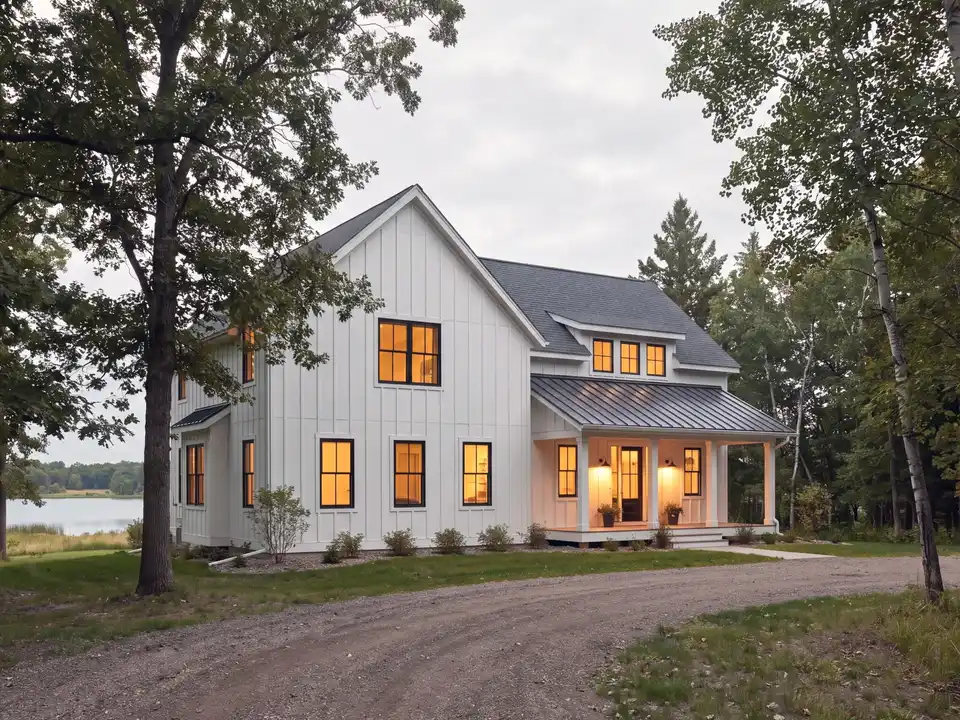
Applying the production band ($230–$300/sq ft) and the custom band ($300–$450/sq ft) to common sizes:
| Size | Profile | Production build | Custom build |
|---|---|---|---|
| 1,800 sq ft | Modest single-level / rambler | $414,000–$540,000 | $540,000–$810,000 |
| 2,400 sq ft | Typical two-story family home | $552,000–$720,000 | $720,000–$1,080,000 |
| 3,200 sq ft | Larger move-up home | $736,000–$960,000 | $960,000–$1,440,000 |
| 4,500 sq ft | Executive / luxury scale | $1,035,000–$1,350,000 | $1,350,000–$2,025,000 |
At 4,500 sq ft most projects are built to the luxury spec ($450–$700/sq ft), which puts construction at roughly $2.0M–$3.15M rather than the standard custom band. Finished basement space typically adds at a much lower per-square-foot rate than above-grade space — one reason Minnesota's full basements are a budget advantage.
Where the Money Goes
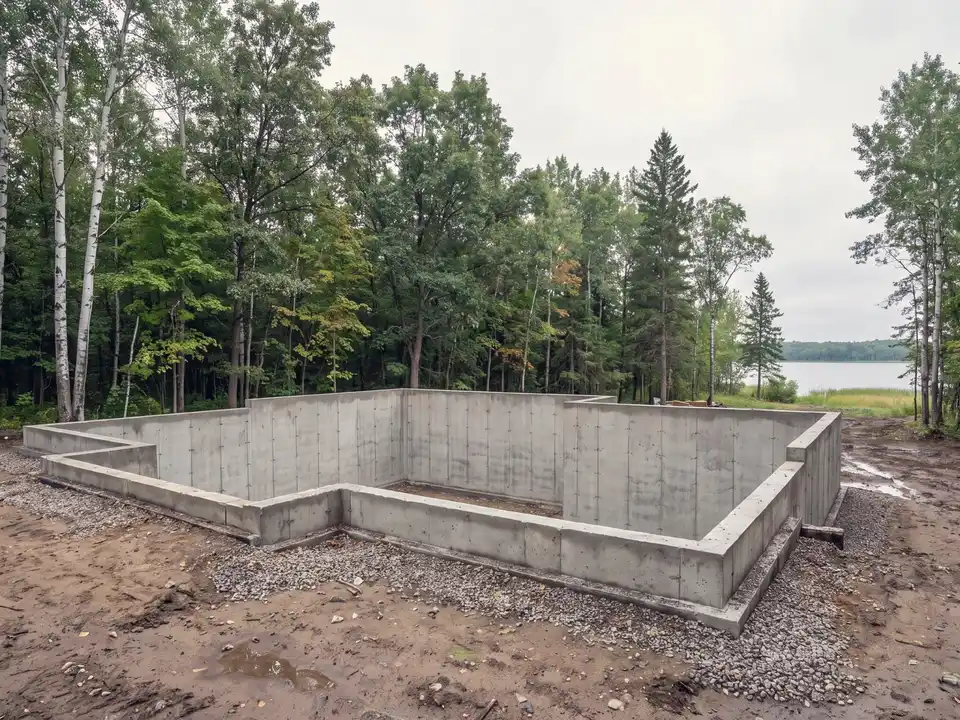
The most recent NAHB Cost of Constructing a Home survey (2024) breaks construction cost into stages. These are national averages — an industry proxy, not Minnesota-specific data (no MN-only breakdown is published), but the proportions are a reliable guide to where your budget actually goes:
| Construction stage | Share of construction cost |
|---|---|
| Interior finishes | 24.1% |
| Major system rough-ins (HVAC, plumbing, electrical) | 19.2% |
| Framing | 16.6% |
| Exterior finishes (roof, siding, windows) | 13.4% |
| Foundations | 10.5% |
| Site work (permits, fees, engineering) | 7.6% |
| Final steps (landscaping, driveway, cleanup) | 6.5% |
| Other | 2.1% |
Minnesota note: local builders report the envelope stage — framing, exterior finishes, and insulation — runs heavier here than the national average because of the cold-climate spec. For scale, NAHB's national averages were $428,215 in construction cost on a 2,647 sq ft home (~$162/sq ft) — well below Twin Cities pricing, which is exactly why we publish local bands.
What Drives the Cost in Minnesota
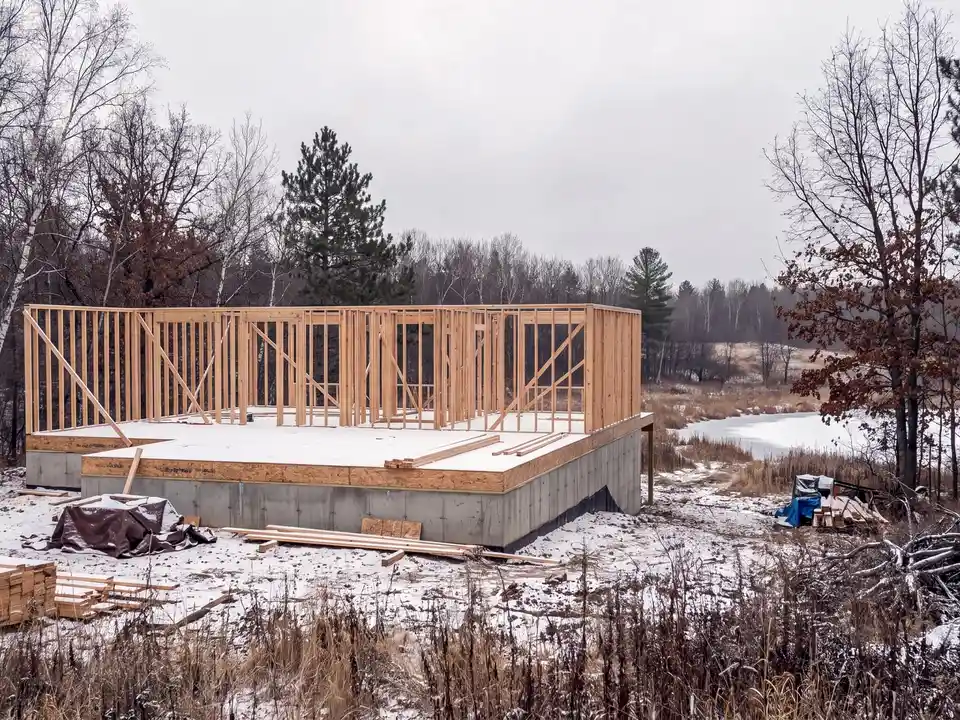
Land and lot conditions. The single biggest variable. A ready-to-build community lot in a growth suburb and a teardown parcel in Edina can differ by $500K+ before a footing is poured. Soils, trees, slope, and utility availability all move the site-work line.
Frost depth and foundations. Absent a determination by an engineer competent in soil mechanics, code sets a minimum footing depth of 3½ feet (42 inches) in Zone II and 5 feet (60 inches) in Zone I — two lists of counties named in Minn. R. 1303.1600, subp. 1, with every Twin Cities metro county in the 3½-foot zone. Either way that means deep footings and, usually, full basements — more concrete than southern builds, but the basement square footage is the cheapest space you'll ever add.
Winter construction. Building through a Minnesota winter adds temporary heat, ground thawing, and weather protection costs. Experienced builders schedule foundations and framing to work with the season rather than against it.
Energy code. Minnesota's energy code is among the stricter in the country: insulation, air-sealing, and mechanical ventilation requirements add upfront cost that returns as lower operating bills.
Finish level. The spread between builder-grade and custom finishes routinely swings total cost 20–40%. Kitchens, baths, and windows are where budgets are won and lost.
Labor market. Twin Cities skilled-trade labor remains tight; established builders with stable subcontractor relationships deliver more predictable pricing than low-bid outliers.
Minnesota Costs, With Sources
The hard numbers behind the ranges above, each tied to a primary source you can check yourself:
- Frost footings. Absent a determination by an engineer competent in soil mechanics, Minnesota Rules 1303.1600, subp. 1 sets a minimum footing depth of 5 feet (60 inches) in Zone I and 3½ feet (42 inches) in Zone II, two lists of counties named in the rule itself — every Twin Cities metro county is Zone II. That is the code reason Minnesota builds deep foundations and, usually, full basements. The rest of what the state code requires of a new house is in our guide to Minnesota's residential building codes.
- Climate zones and insulation. Minnesota spans IECC climate Zone 6A (southern MN, including Minneapolis) and Zone 7 (northern MN) per the MN Department of Labor & Industry. The state's own table, Minn. R. 1322.0402, Table R402.1.1, sets the Zone 6 wood-frame wall at R-20 (or R-13 cavity plus R-5 continuous insulation or insulated siding) and the ceiling at R-49; the Zone 7 wall is R-21.
- Sewer availability charge (SAC). The Metropolitan Council's 2026 SAC rate is $2,485 per single-family unit (unchanged from 2025); some rural-center communities charge more (East Bethel $3,185, Elko New Market $4,685).
- Foundation. Custom-home foundations commonly run $45,000–$90,000 per TC Homes' Minnesota cost guide.
- Site prep and grading. $35,000–$80,000+ depending on soils, trees, slope, and utilities, per Country Joe Homes and TC Homes.
- Well and septic (rural lots). Plan on $20,000–$40,000 where municipal sewer and water aren't available.
- Land. Builder guides put land at roughly 15–35% of total project cost (suburban lots ~20–30%; lakefront higher). NAHB's national average finished-lot share is 13.7% — another place Minnesota metro projects run above the national norm. How many buildable lots each metro city actually has is counted in our survey of vacant residential land in the Twin Cities.
Cost by City
Construction labor and materials are fairly uniform across the metro — what changes city to city is land, lot availability, and project type. Built-out luxury suburbs mean teardown budgets; growth suburbs mean community-lot pricing.
| City | Typical path to new construction | City guide |
|---|---|---|
 Minneapolis Minneapolis | custom + teardown/infill + remodel | Cost to build in Minneapolis → |
 Edina Edina | luxury custom (high value / low volume) | Cost to build in Edina → |
 Wayzata Wayzata | ultra-luxury lakefront custom | Cost to build in Wayzata → |
 Lakeville Lakeville | new construction volume + semi-custom (fastest-growing) | Cost to build in Lakeville → |
 Maple Grove Maple Grove | new construction volume + semi-custom | Cost to build in Maple Grove → |
 Woodbury Woodbury | new construction volume + semi-custom | Cost to build in Woodbury → |
 Plymouth Plymouth | custom + semi-custom (upper-mid to luxury) | Cost to build in Plymouth → |
 Eden Prairie Eden Prairie | custom + semi-custom (upper-mid to luxury) | Cost to build in Eden Prairie → |
 Minnetonka Minnetonka | luxury custom + teardown | Cost to build in Minnetonka → |
 Orono Orono | ultra-luxury estate custom | Cost to build in Orono → |
 Medina Medina | luxury estate custom + new construction | Cost to build in Medina → |
 Chanhassen Chanhassen | custom + new construction (upper-mid) | Cost to build in Chanhassen → |
 Chaska Chaska | new construction volume + semi-custom | Cost to build in Chaska → |
 Blaine Blaine | new construction volume | Cost to build in Blaine → |
 St. Paul St. Paul | remodel + teardown/infill custom | Cost to build in St. Paul → |
 Bloomington Bloomington | remodel + custom (design-build led) | Cost to build in Bloomington → |
No cost guide yet, but a builder hub: Apple Valley, Eagan, Elk River, Excelsior, Prior Lake, Rogers and St. Louis Park.
What Each City Charges: Permit, Plan Review and Water Access
Per-square-foot models stop at the builder’s contract. These three charges are set by the city, by ordinance, and they are the part of the budget a builder cannot negotiate. We read all sixteen cities’ published fee schedules and transcribed them — 45 sourced values across 16 cities, each carrying the document it came from and the date printed on that document (assembled 2026-08-06).
The fee schedules, city by city
Nothing below is calculated. Permit fees are valuation-bracket tables and the valuation is the city’s to set — several schedules say so outright. Publishing “your permit will be $X” would be a guess dressed as a citation, so the schedules are reproduced and linked instead. Full transcriptions are on each city’s page.
| City | Building permit fee | Plan review | Water access charge |
|---|---|---|---|
| Blaine Full schedule → |
Valuation-bracket table. Source As printed: Fee Schedule - Effective January 1, 2026 | Plan Review Fees: When submittal documents are required by MN Rules 1300, a plan review fee shall be paid at the time of permit issuance. Said plan review fee shall be 65 percent of the building permit fee shown above. The plan review fees specified in this subsection are separate fees from the permit fees specified in MN Rules 1300 and are in addition to the permit fees. When submittal documents are deemed incomplete or changed so as to require additional plan review or when the project involves deferred submittal items as defined in MN Rules 1300, an additional plan review fee shall be charged at the rate shown above. Source · as printed: Fee Schedule - Effective January 1, 2026 | Water Availability Charge (WAC) per dwelling unit (residential); per acre (commercial/industrial) Source · as printed: Page states "Last Content Update: Tuesday, April 21, 2026"; same $1,910/unit figure appears in the Blaine Fee Schedule effective January 1, 2026 (https://www.blainemn.gov/4137/Fee-Schedule) |
| Bloomington Full schedule → |
Valuation-bracket table. Source As printed: Bloomington, MN Code of Ordinances, Appendix A: Administrative Relief and Fee Schedule (fees adopted by ordinance), § 15.183(a); code current through 2026 S-16 | § 15.183(b) — Plan Checking Fees - construction value over $1,000,000: 65% of the building permit fee found in "BUILDING PERMIT FEES" table above at § 15.183(a). Source · as printed: Bloomington, MN Code of Ordinances, Appendix A, § 15.183(b); code current through 2026 S-16 | None — no city water access or connection charge is published in the fee schedule. |
| Chanhassen Full schedule → |
Valuation-bracket table. Source As printed: 2026 FEE SCHEDULE, Ordinance Number: 766, Adopted July 13, 2026 (prior year fees set by Ord. No. 754 adopted December 15, 2025, effective January 1, 2026) | Plan Review Fee (If Valuation is More than $3,000) 65% of Permit Fee. State Surcharge — Fee collected on behalf of Minnesota Department of Labor and Industry: .05% of Permit Value. Source · as printed: 2026 FEE SCHEDULE, Ordinance Number: 766, Adopted July 13, 2026 | Water Hook-Up Charge (AKA City WAC) per unit (dwelling unit) Source · as printed: 2026 FEE SCHEDULE, Ordinance Number: 766, Adopted July 13, 2026 |
| Chaska Full schedule → |
Valuation-bracket table. Source As printed: No effective date or fee-schedule year is stated on the page; sitemap.xml reports <lastmod>2026-06-17</lastmod> for this URL | Plan Review Fees: When submittal documents are required, a plan review fee shall be collected at 50% of the normal building permit fee for residential plans. For commercial/industrial plans, a plan review fee shall be collected at 65% of the normal building permit fee. The plan review fees specified in this section are separate fees from the permit fees specified and are in addition to the permit fees. | State Surcharge Computation: Up to $1,000,000: 0.0005 x Valuation; $1,000,001 to $2,000,000: $500 + 0.0004 x Valuation - $1,000,000; $2,000,001 to $3,000,000: $900 + 0.0003 x Valuation - $2,000,000; $3,000,001 to $4,000,000: $1,200 + 0.0002 x Valuation - $3,000,000; $4,000,000 to $5,000,000: $1,400 + 0.0001 x Valuation - $4,000,000; $5,000,000 or more: $1,500 + 0.00005 x Valuation - $5,000,000 Source · as printed: No effective date stated on the page; sitemap.xml <lastmod>2026-06-17</lastmod> | Water Connection per SAC unit (Chaska's water access/connection charge is levied per SAC unit; a single-family home = 1 SAC unit) Source · as printed: No effective date stated on the page; sitemap.xml <lastmod>2026-06-17</lastmod> |
| Eden Prairie Full schedule → | City Code Sec. 10.07 defers permit fees to a Council resolution "a copy of which shall be in the office of the Building Official". No such building-permit valuation resolution is published; the city offers only an online estimator. | Building Inspections Fees & Charges, section "BUILDING INSPECTIONS" > "Fire Alarm & Non-Water Suppression": "Plan checking | 65% of the building permit fee if valuation is greater than $2,000 | 65%". (A parallel line under "Fire Sprinkler Systems" reads: "Plan Check Fee | 65% of the fire-alarm/suppression permit fee if the job value is greater than $2,000 | 65%".) CAVEAT: this 65% line sits under the Fire Alarm & Non-Water Suppression subsection, not under a general building-permit heading; the fee resolution has no general building-permit section. Source · as printed: Resolution No. 2025-115, 'Approve 2026 Fees for City Services', adopted 12/02/2025; fee tables headed '2026' | System Access Charges per Metro SAC unit (residential; a single-family dwelling = 1 SAC unit) Source · as printed: Resolution No. 2025-115, 'Approve 2026 Fees for City Services', adopted 12/02/2025; fee tables headed '2026' |
| Edina Full schedule → |
Valuation-bracket table. Source As printed: Edina City Code Sec. 2-724 Schedule A; codified through Ord. No. 2025-19, enacted 12-16-2025 (Supp. No. 15, Update 3); Schedule A history note ends 'Ord. No. 2025-16, Sec. 1, 12-16-2025' | Row directly under the building permit table in Schedule A: "Plan review | 65% of permit fee". Source · as printed: Edina City Code Sec. 2-724 Schedule A; codified through Ord. No. 2025-19, enacted 12-16-2025 (Supp. No. 15, Update 3); Schedule A history note ends 'Ord. No. 2025-16, Sec. 1, 12-16-2025' | Water connection charge per REC unit per REC unit, multiplied by number of SAC units (single-family home = 1 SAC unit) Source · as printed: Edina City Code Sec. 2-724 Schedule A; codified through Ord. No. 2025-19, enacted 12-16-2025 (Supp. No. 15, Update 3); Schedule A history note ends 'Ord. No. 2025-16, Sec. 1, 12-16-2025' |
| Lakeville Full schedule → |
Valuation-bracket table. Source As printed: City of Lakeville 2026 Fee Schedule - 'Effective January 1, 2026' (footer on every page) | "Plan Check Fees (Adopted by Ordinance)": "65% of building permit fee, except residential permits with less than $10,000 valuation." and "25% of building permit fee for permits issued for similar buildings as required by State Building Code." Source · as printed: City of Lakeville 2026 Fee Schedule - 'Effective January 1, 2026' (footer on every page) | Watermain Unit Charge per dwelling unit Source · as printed: City of Lakeville 2026 Fee Schedule - 'Effective January 1, 2026' (footer on every page) |
| Maple Grove Full schedule → |
Valuation-bracket table. Source As printed: City of Maple Grove 2026 Fee Schedule, Ordinance 25-17 - Appendix A (no explicit effective date printed in document) | "Plan review fees are 65% of building inspection fees below" Source · as printed: City of Maple Grove 2026 Fee Schedule, Ordinance 25-17 - Appendix A (no explicit effective date printed in document) | Water access charges (WAC) per dwelling unit Source · as printed: City of Maple Grove 2026 Fee Schedule, Ordinance 25-17 - Appendix A (no explicit effective date printed in document) |
| Medina Full schedule → |
Valuation-bracket table. Source As printed: Amended March 17, 2026 | Building Plan Review: 65% of building permits Source · as printed: Amended March 17, 2026 | Connection Rates per living unit (residential); amount varies by water service area — $7,575 Hamel Urban Service Area, $4,410 Independence Beach, $4,410 Medina Morningside, $1,000 + Maple Plain's own fee for the Maple Plain Service Area Source · as printed: Amended March 17, 2026 |
| Minneapolis Full schedule → |
Valuation-bracket table. Source As printed: Last updated on February 27, 2026 (per the hosting city page; the published fee sheet itself carries no date) | Plan Review Fee (65% x building permit fee). MN State Surcharge (Value of Work x 0.0005). Source · as printed: Last updated on February 27, 2026 | None — no city water access or connection charge is published in the fee schedule. |
| Minnetonka Full schedule → |
Valuation-bracket table. Source As printed: Revised Jan. 1, 2026 | "Plan Review Fee. This fee, which covers the cost of staff review, is equal to 65% of the building permit fee." "State of Minnesota Surcharge. The fee, which is paid to State and required by state statute is 0.0005 of the valuation of the permit, if under $1,000,000. For valuations over $1,000,000, please contact the Inspections Division." Source · as printed: Revised Jan. 1, 2026 | Water Residential Equivalency Charge $2,473 per SAC unit (a single-family home = 1 SAC unit) Source · as printed: Revised Jan. 1, 2026 |
| Orono Full schedule → |
Valuation-bracket table. Source As printed: City of Orono 2026 Fee Schedule, Ordinance 320, Adopted February 9, 2026, Effective January 1, 2026 | "Plan Review Fee: 65% of Building Permit Fee"; "Rereview Plan Fee: Up to the cost of the Plan Review Fee Based on Building Offical Recommendation". State surcharge: "State Surcharge as required by State." (no rate stated in the fee schedule). Source · as printed: City of Orono 2026 Fee Schedule, Ordinance 320, Adopted February 9, 2026, Effective January 1, 2026 | WATER CONNECTIONS $4,370 per unit (per residential connection) for connection to the existing City of Orono water main; $2,470 per unit if connecting to the Wayzata water system; Long Lake system connections are charged at the adjacent city's current fee Source · as printed: City of Orono 2026 Fee Schedule, Ordinance 320, Adopted February 9, 2026, Effective January 1, 2026 |
| Plymouth Full schedule → |
Valuation-bracket table. Source As printed: Updated 1/14/2026 (footer of the "City of Plymouth Building Permit Fees" handout; file stamp IB\APPS HANDOUTS INFO\Building Fee Schedule.docx). No ordinance or resolution number is printed; the document states "The following fees are adopted as part of the Plymouth City Code." | 2. PLAN REVIEW
This amount is 65% of the Building Permit Fee. Multiply .65 x the Building Permit Fee which you calculated in #1 on page 1. Do not use the original building valuation amount. Source · as printed: Updated 1/14/2026 (footer of the "City of Plymouth Building Permit Fees" handout; file stamp IB\APPS HANDOUTS INFO\Building Fee Schedule.docx). No ordinance or resolution number is printed; the document states "The following fees are adopted as part of the Plymouth City Code." | REC (CITY) RESIDENTIAL EQUIVALENT CONNECTION CHARGE per dwelling unit Source · as printed: Updated 1/14/2026 (footer of the "City of Plymouth Building Permit Fees" handout; file stamp IB\APPS HANDOUTS INFO\Building Fee Schedule.docx). No ordinance or resolution number is printed; the document states "The following fees are adopted as part of the Plymouth City Code." |
| St. Paul Full schedule → |
Valuation-bracket table. Source As printed: 2023-02-25 (schedule states "Effective: 2/25/2023"; PDF file modified 2023-02-28) | PLAN CHECK FEE: "Valuations <= $1,000 = no fee"; "Valuations > $1,000 = 65% of permit fee from table above" Source · as printed: 2023-02-25 (schedule states "Effective: 2/25/2023") | None — no city water access or connection charge is published in the fee schedule. |
| Wayzata Full schedule → |
Valuation-bracket table. Source As printed: 2026 (document titled "2026 BUILDING PERMIT FEE SCHEDULE" / "2026 Approved Fee Schedule"; no separate adoption date printed) | "Plan review = 65% of permit fee"; "Plan review of residential interior remodel = 35% of permit fee"; "Plan review of similar plans = 25% of permit fee" Source · as printed: 2026 ("2026 Approved Fee Schedule") | City WAC fee per connection / per single-family dwelling unit (schedule states a flat amount; no per-unit qualifier printed) Source · as printed: 2026 ("2026 Approved Fee Schedule") |
| Woodbury Full schedule → |
Valuation-bracket table. Source As printed: 2026 (document titled "2026 Fee Schedule - Final Version"; column header "2026 Fee") | Plan review fee: "Standard = 65% of building permit fee"; "Plan review for similar plans (6-19, MN Rules 1300.0160, subp. 5) = 25% of normal building permit fee"; "Planning and zoning review and verification = $100.00"; "Licensed facilities plan review and verification = $100.00" Source · as printed: 2026 ("2026 Fee Schedule - Final Version") | Water Area Charge per dwelling unit (detached SFH density band: one to four dwelling units/acre) Source · as printed: 2026 ("2026 Fee Schedule - Final Version") |
Eight different names for one charge. Blaine calls it a Water Availability Charge, Chanhassen a Water Hook-Up Charge, Eden Prairie a System Access Charge, Edina a per-REC connection charge, Lakeville a Watermain Unit Charge, Plymouth a WREC, Woodbury a Water Area Charge, Wayzata simply a City WAC fee. Each city’s own term is used above rather than a normalised one, because the variety is the evidence: this is sixteen fee schedules read one at a time, not one table scraped from somewhere.
What We Could Not Source, and Why That Is the Answer
Four of these findings are absences. They are recorded as facts because they change what a build costs, and because a model that fills every cell cannot tell you about them.
The four absences
- Bloomington, Minneapolis and St Paul levy no water access charge at all. Thirteen of the sixteen do. A budget built from a generic “Twin Cities” assumption overstates the cost of building in the three core cities by the amount of a suburban water access charge — a four-figure sum per dwelling unit in most of the suburbs above.
- Eden Prairie publishes no building permit valuation table. City Code Sec. 10.07 defers permit fees to a Council resolution “a copy of which shall be in the office of the Building Official”. No such resolution is published; the city offers an online estimator instead. We record that rather than estimating a fee for it.
- Chaska’s schedule is cited by its own code but carries no printed
date. The page states no effective date or fee-schedule year. The only date
evidence is the site’s own sitemap
lastmod. That is what we show, labelled as what it is. - Medina has no single citywide water charge. It publishes four area-specific trunk connection rates — Hamel Urban Service Area, Independence Beach, Medina Morningside, and the Maple Plain Service Area, which adds Maple Plain’s own fee on top. Which one applies depends on where the lot sits.
Dates are reproduced exactly as each city prints them, and they are not uniform: some publish an ordinance number and an adoption date, others only “Updated 1/14/2026”, and one schedule still in force is dated 2023. Flattening those into one tidy “last updated” column would destroy the only signal a reader has about how current a city’s fees are.
Financing & Permits
Most custom builds use a construction-to-permanent ("single-close") loan: one closing, with the construction loan converting to a permanent mortgage at completion. Lenders typically want around 20% down — the common range is 10–25%, and some Minnesota community banks offer 5–10% programs — plus the builder's contract and budget, with draw inspections at milestones. Production purchases in builder communities usually finance like a normal home purchase.
Permit costs vary by city but typically total 1–2% of construction value across building, plumbing, mechanical, and electrical permits plus plan review, sewer/water access charges (SAC/WAC) in metro cities, and park dedication fees in some growth suburbs. Your builder should carry these as a line item — ask.
Related reading: permits & inspections, budgeting a custom home, and change orders in the glossary.
Frequently Asked Questions
How much does it cost to build a house in Minnesota in 2026?
For most Twin Cities metro buyers, plan on $230–$300 per square foot for a production home in a builder community, $250–$400 for semi-custom, and $300–$450+ for full custom construction, before land. A typical 2,400 sq ft custom home therefore runs roughly $720,000–$1,080,000 in construction cost alone.
Is it cheaper to buy or build in Minnesota?
Existing homes usually cost less per square foot than new construction, but the comparison is rarely apples-to-apples: new builds carry modern energy code performance (meaningfully lower heating bills in MN), full warranties, and zero deferred maintenance. In fast-growing suburbs where builder communities are active, the gap narrows considerably.
What is the cheapest way to build a house in Minnesota?
Production and townhome communities are the most attainable path (builder-owned lots, set plans, volume pricing). Among self-directed builds, modular ($150–$250/sq ft) and barndominium ($120–$220/sq ft) construction typically come in below conventional site-built custom ($300–$450+/sq ft), with the caveat that land, well/septic, and site work are on top.
How much does land cost in the Twin Cities?
It ranges enormously: community lots in growth cities like Lakeville, Blaine, or Chaska can run $120K–$250K; scarce infill and teardown lots in Minneapolis, Edina, or Minnetonka commonly cost $400K–$1M+ because you are buying (and demolishing) an existing house; and Lake Minnetonka shoreline is effectively a separate market measured in millions. Across most projects, land ends up around 15–35% of the total budget.
How long does it take to build a house in Minnesota?
Production homes typically deliver in 5–8 months from contract; custom homes run 10–16 months including design. Minnesota winters are built into every experienced builder’s schedule: foundations poured before deep frost, interior trades through the cold months.
Methodology & Sources
These are planning ranges, not quotes — budget a 10–15% contingency and get 2–3 local bids. Last updated July 2026.
How we built these numbers
How we built these numbers. Per-square-foot ranges are synthesized from 294 priced 2026 Parade of Homes listings across 83 Twin Cities builders in our directory, cross-checked against published 2026 pricing from local custom builders (TC Homes, Country Joe Homes, Sustainable 9) and national survey data from the National Association of Home Builders. The listing dataset is priced listings, not final bids, and skews toward custom and Parade-tier work.
Minnesota-specific figures are sourced to primary references: footing depth from Minnesota Rules 1303.1600, sewer availability charges from the Metropolitan Council, climate-zone and energy-code requirements from the MN Department of Labor & Industry, and the 2038 energy-code cost estimate from the Housing Affordability Institute (a figure contested by efficiency advocates, including Fresh Energy).
Get Real Numbers for Your Project
Planning ranges are the start, not the answer. The fastest way to a real number is 2–3 bids from builders who actually work in your city. Get matched free and we'll shortlist them, or browse builders by city.